What Is BookTok and How Authors Can Use It
The way we find our next read is no longer limited to browsing bookshelves at a local bookstore or scrolling through the NYT Bestsellers list. Instead, it’s about being where the readers are, and lately, that’s TikTok. Statistics show that nearly half of all users now treat the platform like a search engine, with a staggering 72% of people discovering their new favorite brands and products simply by scrolling through their feed.
For authors and readers, this shift has fueled a massive movement known as BookTok. It’s the place where writers drop the formal author persona and just act like people, using the app as a matchmaker to pair their book’s unique “vibe” with readers who’ve been looking for it all along.
In this article, we’ll answer the question: What is BookTok? We’ll also share actionable strategies to help you build a community around your work, master the algorithm, and ultimately see that momentum reflected in your sales.

What Is BookTok?
BookTok is a massive sub-community of readers and writers on TikTok who share a passion for all things literary. It started as, and still is, a viral hashtag (#BookTok) used to categorize book-related videos. Think of this hashtag as the “digital address” where book lovers hang out. As of 2026, the #BookTok tag has billions of views, which makes it one of the most powerful corners of the app.
BookTok is much more than just a hashtag; it’s like a book club that never sleeps. Instead of formal literary critics, you have “BookTokers”: everyday readers who share their unfiltered, often emotional reactions to what they’re reading. They don’t just review a book; they celebrate its vibe, aesthetics, and tropes. This makes it a great opportunity for you as an author to connect with readers who enjoy the type of stories you write.
Why Should Authors Care about BookTok?
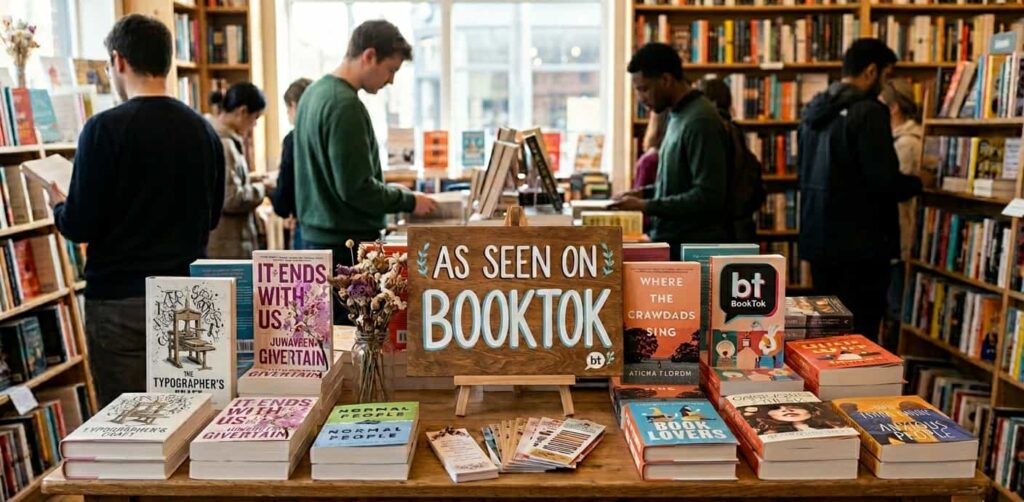
The reason people call BookTok a “movement” is its massive impact on the physical world. You’ve likely noticed the “As Seen on BookTok” tables at major bookstores, which exist because this community can turn a years-old title into a bestseller overnight. While traditional marketing focuses on what’s “new,” TikTok’s algorithm prioritizes what is relevant to the reader, which means that you can create content about a book you published years ago and still manage to find a massive new audience.
However, keep in mind that BookTok isn’t a magic button for instant riches. While having one of your TikToks go viral is the dream, the real value for writers is in building a long-term community. By showing up consistently and sharing the human side of your writing, you’ll be able to create a loyal fanbase that will support your entire career, not just one release.
It’s also important to note that, while the community has grown to include almost every niche imaginable, it remains the ultimate home for Young Adult, Fantasy, and Romance. So if your work falls under any of these genres, you’ll find on BookTok many readers who are already gathered and looking for exactly what you’ve written.
Understanding How BookTok Works
Before getting into the strategies you can use to benefit from BookTok as an author, it’s important to first understand that it doesn’t work like traditional libraries or online book platforms. Instead of categorizing books by broad genres, your content appears to readers who are interested in the tropes and feelings you address in your work. Readers there aren’t just looking for “Romance” or “Mystery”; they are searching for specific vibes like #EnemiesToLovers, #FoundFamily, or #HeFallsFirst. This means your focus should be on identifying the one emotional hook in your story that makes readers unable to put it down.
The best way to find the right audience for your book is to explore the niches that already exist. If you write high-stakes magic weaved with romance, for example, hang out in #Romantasy. If you’ve written a twisty thriller, look into #ThrillerTok. As you spend some time scrolling through these hashtags, you’ll see exactly what readers are excited about, which you can then use in your videos.
The important thing here is not to worry about trying to appeal to everyone. In fact, trying to reach everyone usually leads to reaching no one, so the more specific you are, the better. Whether you’re writing about a grumpy detective who loves cats or space pirates with a heart of gold, there is a corner of BookTok waiting for exactly that. So once you identify your tropes, it’d be much easier to create content that lands on the right “For You” pages.
How to Use BookTok as an Author
If you’re new to TikTok, it’s easy to assume you need to be a professional filmmaker to turn a fifteen-second clip into a real connection with a reader. Luckily, that isn’t the case at all! You just need to understand the culture of the BookTok community. To help you make the move from writer to creator, we’ve put together ten essential strategies and best practices.
1. Set Your Goals
Before you film your first video, you need to decide what success looks like for you. While the goal is ultimately to sell your books, the most successful authors on TikTok focus on long-term community building rather than just a one-off viral sale. If the content you share feels like ads, people will scroll past your videos; but if you treat it like a digital coffee shop where you chat about your work and the books you love reading, you’ll build a loyal fanbase.
2. Have a Steady Posting Schedule
Once you have that mindset, you need a sustainable posting schedule. You don’t have to post every hour to stay relevant. Try to have 3 to 5 posts per week. This is the sweet spot; it’s frequent enough to keep the TikTok algorithm showing your videos to new people, but manageable enough that it won’t take away from your actual writing time nor overwhelm you.
3. Master the Hashtag Game
TikTok doesn’t just show videos to random people; it scans your hashtags and captions to decide who would actually like your book, then shows it to them. To take advantage of this, it’s a good idea to think of your hashtags as a pyramid with 3 layers, from the most general audience at the bottom to your specific fans at the top:
- The Base (Broad Tags): Use 1–2 general hashtags, such as #BookTok or #ReadingCommunity. These are broad categories that tell TikTok, This video is for people who love books.” It puts you in the largest possible pool of viewers.
- The Middle (Niche/Genre Tags): Use 2–3 tags specific to your genre, like #Romantasy, #HistoricalFiction, or #YAThrillers. This is the most important layer as it connects you with readers who are actively looking for the exact type of story you’ve written.
- The Peak (Bespoke/Custom Tag): Use 1 unique tag for your book, such as #YourBookTitle or #AuthorName. This acts as a digital archive. When a reader finishes your book and wants to see more, they can click this tag to find every video you’ve ever made about it in one place.

4. Use the 80/20 Rule to Build Trust
It may feel counterintuitive to spend most of your time talking about other people’s work, but the best way to sell your book is to first become a trusted member of the community. This approach trains the algorithm to associate your profile with specific interests and grow an audience that already loves your niche. By the time you pitch your own book, you aren’t a stranger selling a product to them; you’re a fellow book-lover sharing a project your audience is already primed to enjoy. Here’s how you can do that:
- Focus 80% on Community & Vibe: Spend the majority of your time sharing your favorite reads, writing struggles, or adjacent content (the hobbies and interests your readers likely share) that fit your genre. For example, if you write historical fiction, share fun facts about the era you’re interested in or writing about, or if you write mythology-inspired fantasy, discuss your favorite myths.
- Spend 20% on Promotion: After building an audience that is aligned with your literary taste, it’s time to talk about your work. You can reserve the other 20% of your content for direct promotion, such as cover reveals, pre-order announcements, or character teasers.
5. Win the Three-Second Hook
TikTok is designed for speed. If you don’t grab a reader’s attention immediately, they’ll swipe past before you’ve even said hello. To stop them from scrolling away, you need a hook (AKA a specific reason for a stranger to stop and watch). Below are the types of hooks you can use in your TikToks to grab attention:
- The visual hook: Use bold text on the screen that hits an emotional nerve. Instead of “Here’s my New Book,” try sharing short, high-impact snippets of your writing. Instead of explaining the story, show the tension. A “gut-punch” line or a “romantic tease” gives readers a direct sample of your writing style and the emotional payoff they can expect. Another idea is to use imagery to trigger an immediate emotional response. If you write a gritty thriller, for instance, use quick-cut images of rainy streets and neon signs. For Dark Academia, you can focus on flickering candles and ink-stained fingers.
- The verbal hook: Skip the introductions and start in the middle of the action. Read a shocking line of dialogue or a “What If?” scenario that speaks directly to your genre’s fans. You can also use the first line challenge: simply read the opening sentence of your manuscript and ask, “Would you keep reading?” You aren’t trying to tell the whole story here; you’re just trying to create enough curiosity that they stay for the remainder of the video.
6. Lean into POV (Point of View) Content
POV videos are the secret language of TikTok because they make the viewer part of the writing process. Instead of summarizing what happens to your characters, you are inviting the reader to inhabit your world and experience the story as if they were the protagonist. This builds an immediate sense of investment that a standard pitch simply can’t match. For instance, you can use:
- The role-play caption: Use bold text on the screen to tell the viewer who they are in this scene. For example: “POV: You’re the villain’s apprentice, and you just found out he’s been protecting you this whole time.” This gives the viewer immediate context for what they are about to see.
- The “lenses are eyes” technique: Look directly into the camera lens and speak your dialogue as if the viewer is standing right in front of you. By addressing the camera as a character rather than an audience, you create an intimate, interactive experience that feels like a scene from a movie.
For example, lean in close to the lens, lower your voice, and look directly into the camera. Speak the line as if the viewer is the assassin, “You really thought you could hide that dagger in a ballroom full of mirrors? I’ve been watching you since you walked through the door, darling.“ - The “what would you do?” angle: Set up a tense cliffhanger or a moral dilemma from your manuscript. Then explain a difficult choice your character has to make and ask your audience how they would react in that situation.
Here is an example to make it clearer: You are writing a fantasy, and you ask your readers, “Your kingdom is under a curse that will destroy everyone by sunrise. The only way to break it is to sacrifice the person you love most. Would you let the world burn to save your person, or would you be the hero and lose them forever? Let me know in the comments, because my main character is currently staring at the altar and I don’t know what she’s going to do.“
7. Share the Human Side of Your Journey
While readers may love your stories, they stay for you. Showing the “behind-the-scenes” reality of being an author builds a level of trust and emotional connection that polished marketing can’t buy. When your followers feel like they are part of your journey, they become your most dedicated fans when launch day arrives. To build such trust, you can try the following ideas:
- Celebrate the small wins: Don’t wait for the book deal to share your book with your readers. Post about finishing a difficult chapter, hitting a word count goal, or finally getting your character’s name right. These “micro-milestones” invite your audience to celebrate with you.
- Show the messy middle: Share the reality of the creative process: the coffee-stained desks, the piles of research books, or the funny writer problems like accidentally researching “how to hide a body” for a thriller. Vulnerability makes you relatable rather than just a name on a cover.
- Share the big reveal moments: Document the high-energy milestones, like unboxing your first physical proof copy or seeing your cover art for the first time. The joy in these videos is infectious and gives your followers a sense of “we did it” because they’ve been following your progress.
8. Turn Readers into Collaborators
Engagement is a two-way street. Instead of just presenting your finished work, invite your audience into the creative process. When readers feel like they have a say in your world, they become far more invested in seeing the book succeed. This strategy also signals to the TikTok algorithm that your content is worth promoting because it generates a conversation.
Here are a few ideas you can try in a TikTok Live or in one of your videos:
- The “what if” scenario: Ask your followers to help you solve a plot point or a character dilemma. For example: “I’m stuck. Does the protagonist find the secret letter in the library, or is it hidden in her rival’s desk? Tell me which choice is more chaotic.”
- Polls and preferences: Use the voting features to let fans weigh in on non-spoiler details. Ask them to help you choose between two different aesthetics for a character’s room, or pick which of two specific tropes they want to see in your next chapter.
- React to fan theories: Once you have a few chapters out or a blurb shared, film yourself reacting to what people think will happen. Even if they are wrong, your acknowledgment makes them feel seen and encourages more people to join the discussion.
9. Match Trends with Purpose
On TikTok, trends move fast, but you don’t have to jump on every viral sound to be successful. The most effective way to use a trend is to repurpose it so it serves your book’s specific brand. For instance, instead of just following a trend, ask yourself: “How would my characters react to this?”
One way to do this is to take a popular trending sound and apply it to a specific character dynamic in your book. If there is a viral sound about a “betrayal,” use it to highlight the tension between your protagonist and the villain, for example. This makes the trend feel like a custom teaser rather than a generic video.
10. Convert Views into Sales
The ultimate goal of your content is to turn a casual viewer into a lifelong reader. To do that, you need to make the path from your video to your ‘buy’ link as seamless as possible. By making the purchase steps clear, you ensure that someone who falls in love with your story or your “vibe” can easily get their hands on the book. To turn that digital interest into actual sales, focus on these three pillars of conversion:
- The one-click bio: Your “Link in Bio” is your most valuable piece of digital real estate. Use a landing page (like Linktree or your website) that puts your book at the very top. If a reader has to search for where to buy, they’ll likely move on to the next video.
- Host live launch events: Use TikTok LIVE for Q&As or “Read with Me” sessions. This real-time interaction creates a sense of urgency and excitement. Seeing your passion for the story in person is often the final nudge a follower needs to hit the buy button.
- Let the data guide you: Periodically check your TikTok analytics to see which videos are driving Profile Visits. If your “POV” videos are bringing people to your bio more than your “Day in the Life” clips, you’ll know exactly where to focus your energy to grow your sales.

Wrapping Up
Navigating BookTok as an author is a bit like being the protagonist in a slow romance: it takes some patience, a little trial and error, and the occasional feeling that you’re talking to a brick wall. But once the algorithm finally serves you with the right audience, the connection is more rewarding than a perfectly executed plot twist.
Remember that you don’t need to be a professional cinematographer or a viral dancer to succeed. Just focus on being the reader’s favorite kind of author, the one who is actually excited to share the journey. So go ahead, hit record, and stop the scroll; your future readers are already out there, they just need you to help them find their next favorite book.
More from Our Blog